WhatsApp logo

Blog

Settling in Switzerland: the real timeline, permit by permit

Permits, registration, tenancy agreement, insurance: every step has a precise legal deadline. Miss one, and you pay.

Particulier
Settling in Switzerland: the real timeline, permit by permit

Which residence permit applies to your situation?

Before signing anything, you need to know which permit applies to your case. Confusing a Permit B with a Permit L can cost weeks of procedural delay.
The four common permits in Geneva:
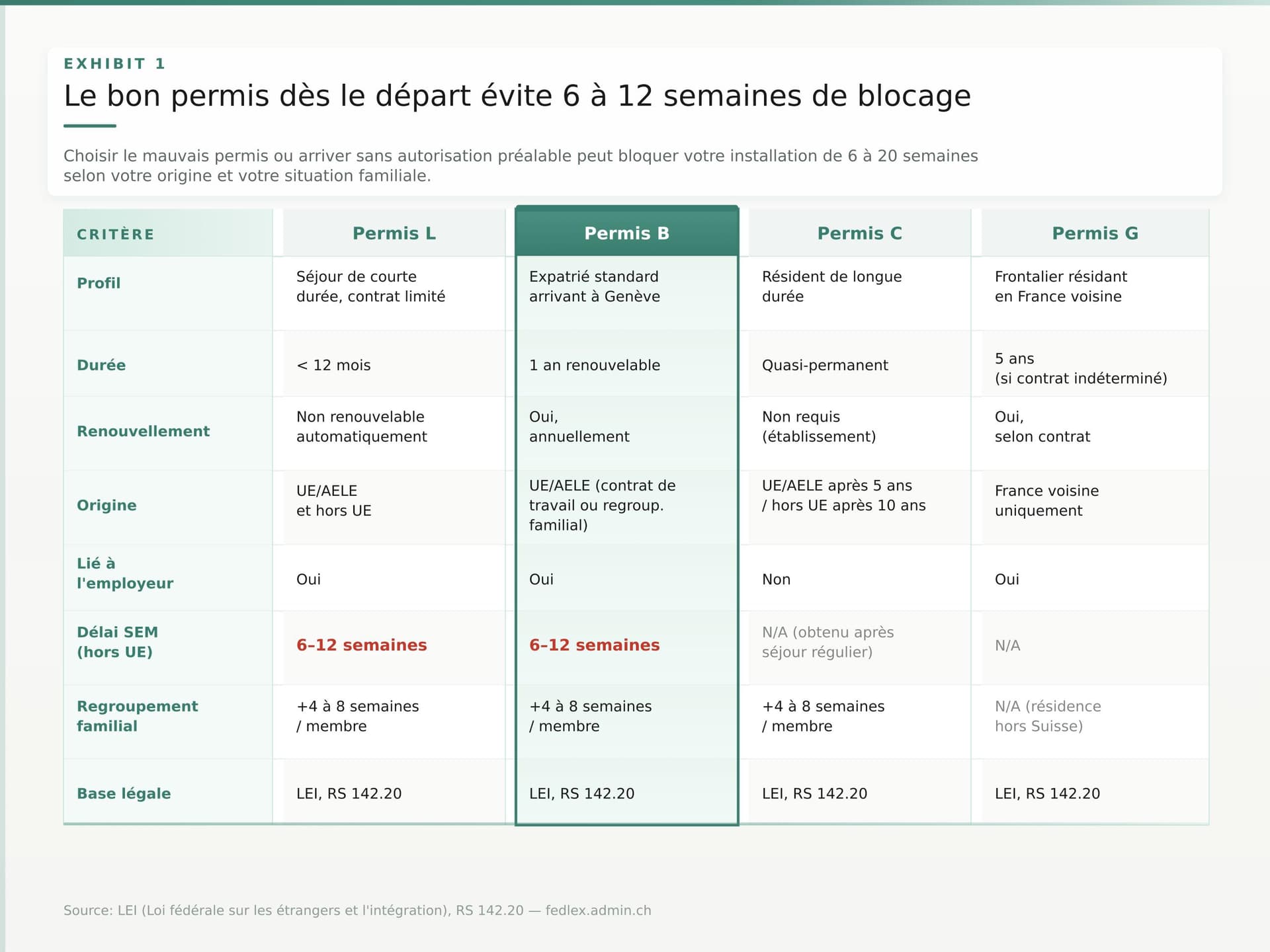
  • Permit L: short-term residence, less than 12 months, tied to a fixed-term employment contract. Not automatically renewable.
  • Permit B: one-year renewable residence permit, for EU/EFTA nationals with an employment contract or family reunification. This is the standard permit for an expatriate arriving in Geneva.
  • Permit C: settlement permit, obtained after 5 years (EU/EFTA) or 10 years (non-EU) of regular residence. Quasi-permanent and not tied to an employer.
  • Permit G: frontier worker permit, for persons residing in neighbouring France and working in Geneva. Valid for 5 years if the employment contract is open-ended.
Legal basis: the Federal Act on Foreign Nationals and Integration (LEI [Loi sur les étrangers et l'intégration], RS 142.20), available at fedlex.admin.ch, governs all of these categories.
For non-EU/EFTA nationals, the admission procedure is distinct: the employer must request prior authorisation from the State Secretariat for Migration (SEM [Secrétariat d'État aux migrations]) before your arrival. Processing time ranges between 6 and 12 weeks depending on the complexity of the file. Do not arrive in Switzerland without this authorisation in hand.
If your situation involves family reunification, allow an additional 4 to 8 weeks for each family member. Each minor child is the subject of a separate application to the OCPM.
For a full overview of the 12 critical points before arriving, consult our guide on things to know before settling in Switzerland.

Arrival notification and municipal registration: who does what?

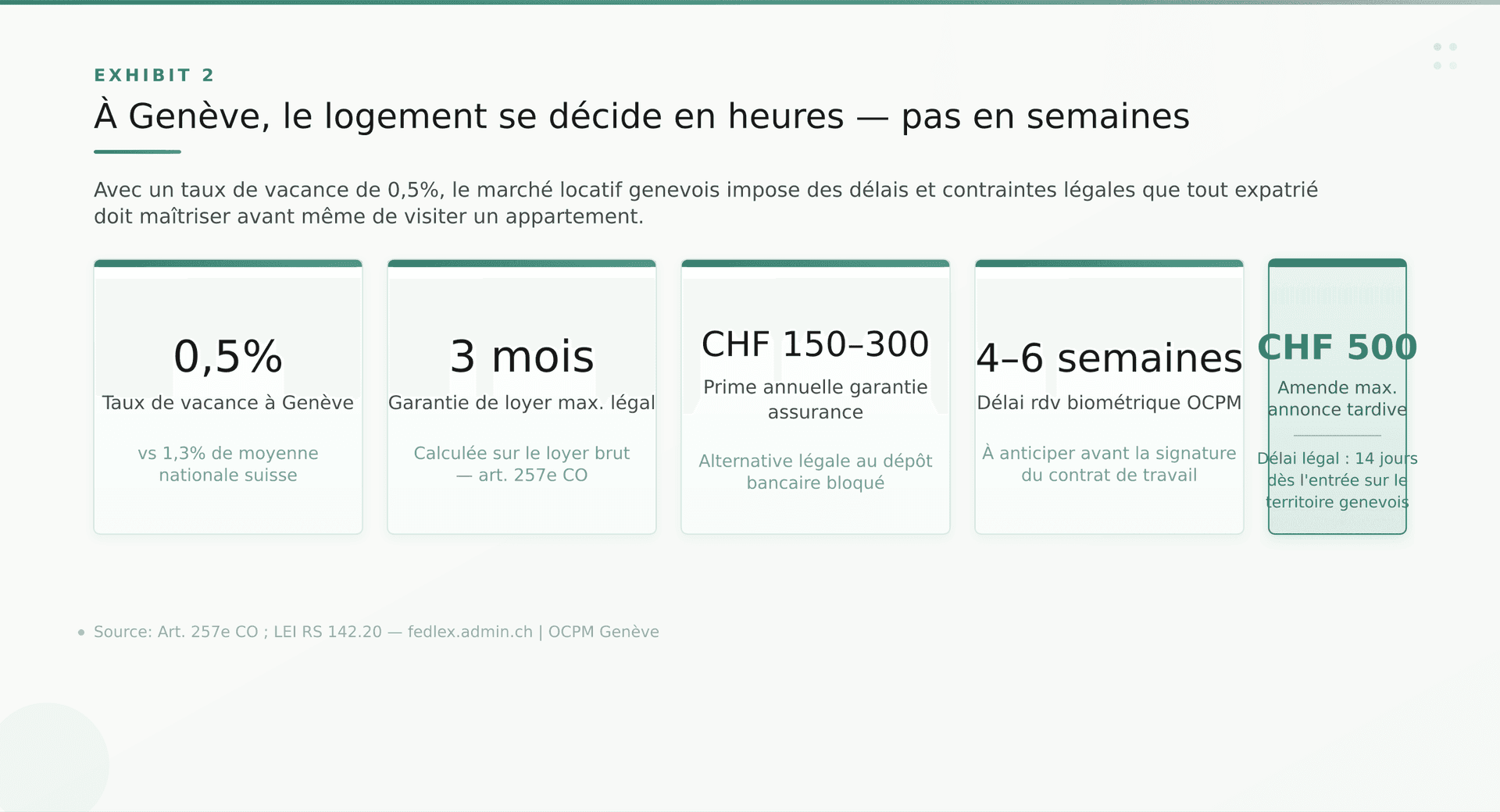
The legal deadline for arrival notification is 14 days from the date of entry onto Geneva territory. Beyond this deadline, the municipality may impose an administrative fine. In Geneva, it is the OCPM (Office cantonal de la population et des migrations [Cantonal Office for Population and Migration]) that centralises registration, unlike Vaud where it is the SPOP, or Fribourg which has its own cantonal OCPM.
In Geneva, the procedure takes place in two stages:
1. Submit the arrival notification form online or at the OCPM counter, with the employment contract, signed tenancy agreement and identity documents. 2. Attend the biometric appointment for the recording of fingerprints (compulsory for non-EU/EFTA nationals). This appointment is scheduled by the OCPM and takes between 4 and 6 weeks to obtain after the initial notification.
The physical residence permit (titre de séjour) is only issued after the biometric appointment. During this period, the notification certificate serves as a provisional document. Keep it on your person at all times.
Key figures:
  • Fine for late notification: up to CHF 500 depending on the municipality.
  • Biometric appointment lead time in Geneva: 4 to 6 weeks (allow for this delay before signing your employment contract).
  • Required documents: valid passport, 2 identity photographs, employment contract or proof of resources, signed tenancy agreement.
If you have a family, each adult member must appear in person. Minor children are registered together with their parents but require their own individual file.
Comparative table: Permit L vs Permit B vs Permit C vs Permit G across 8 criteria. Source: LEI (Federal Act on Foreign Nationals and Integration), RS 142.20 — f
Settling in Switzerland: the real timeline, permit by permit — The right permit from the outset avoids 6 to 12 weeks of delays

Housing: signing a tenancy agreement without falling into a trap

The Geneva rental market is one of the tightest in Switzerland: the vacancy rate hovers around 0.5%, compared with a national average of approximately 1.3%. You do not have the luxury of taking three weeks to think it over.
What a Geneva landlord systematically requires before signing:
  • Extract from the debt enforcement register (Office des poursuites), dated within the last 3 months (to be requested from the debt enforcement office of the canton of your previous domicile).
  • Proof of income (the last 3 payslips or a signed employment contract).
  • Copy of the residence permit or arrival notification certificate.
  • Rent deposit: must be lodged in a blocked bank account in the tenant's name. The maximum legal amount is 3 months' gross rent (Art. 257e CO [Code of Obligations]).
A note of caution regarding the rent deposit: some landlords request a surety insurance guarantee (from a private company) rather than a bank deposit. Both are legal. The bank guarantee ties up your funds; the insurance guarantee costs an annual premium of approximately CHF 150 to 300 depending on the guaranteed amount.
ASLOCA (Association genevoise de défense des locataires [Geneva Tenants' Association]) publishes standard lease templates and a guide to tenants' rights. Verify that your tenancy agreement complies with the clauses required under Swiss tenancy law (CO, Art. 253 to 274).
Rigorous tenant screening is the norm in Geneva. Consult our guide on tenant selection in Switzerland to understand what landlords actually check.

Entry inspection report: the checklist that prevents disputes

The entry inspection report is the document that will determine what you are required to pay upon vacating the property, sometimes two or three years later. In Switzerland, disputes at the time of handover represent the primary source of litigation between tenants and landlords.
What you must check and record in writing on the day of entry:
  • Condition of every wall, floor and ceiling (scratches, stains, holes, damp).
  • Functioning of every fitting: sockets, light switches, shutters, water heater, cooker, dishwasher.
  • Condition of windows and seals (condensation, cracks).
  • Meter readings (cold water, hot water, electricity if individually metered).
  • Number and condition of keys handed over.
Photograph every defect noted, with a date embedded in the image. Send these photographs to the landlord by registered post within 3 days of receiving the keys. Beyond this deadline, any defect that has not been reported will be presumed to have occurred during your tenancy.
If the landlord refuses to note a defect in the inspection report, flag it in a separate registered letter. Signing the report without reservations is legally binding.
A poorly conducted entry inspection can cost several thousand francs at the end of the tenancy. Our article on apartment handover in Switzerland details the documents to insist upon and the remedies available.
Key figures: Vacancy rate in Geneva, maximum legal rent deposit, annual surety insurance premium, OCPM biometric appointment lead time. Source: Art.
Settling in Switzerland: the real timeline, permit by permit — In Geneva, housing decisions are made in hours — not weeks

International removal: customs, exemptions, deadlines

Importing your personal belongings from abroad is exempt from customs duties and VAT under specific conditions. The customs exemption applies to goods that have belonged to the declarant for at least 6 months and are imported within 2 years of the transfer of domicile to Switzerland.
Conditions that must be met without exception:
  • Submit a customs declaration (form 18.44) at the point-of-entry customs post on the day of crossing.
  • Attach a detailed list of the goods being imported (inventory in French or English, with an estimated value).
  • Present proof of change of domicile: certificate from the OCPM or the municipality of arrival.
The staged-removal trap: if you bring in a first batch of your belongings before being officially registered in Switzerland, and then a second batch 14 months later, the second consignment no longer benefits from the exemption. Goods imported more than 24 months after installation are taxed at the standard VAT rate (8.1%).
For vehicles: the importation of a personal car is subject to distinct rules. You have 12 months from arrival to register the vehicle in Switzerland. Beyond this period, the vehicle is treated as a commercial importation and taxed accordingly.
Allow 1 to 3 working days for customs clearance in the event of a physical inspection. Removals originating from non-EU countries are subject to more frequent checks.

Compulsory insurance (LAMal, personal liability): legal deadlines

Two insurance policies are non-negotiable from the moment you arrive in Switzerland. Ignoring or delaying them has direct financial consequences.
LAMal (compulsory health insurance):
The enrolment deadline is 3 months from the date of entry onto Swiss territory. Beyond this deadline, the insurer designated ex officio by the canton may backdate cover to the date of arrival, but premiums are then charged retroactively for the months during which you were not enrolled, without any opportunity to choose your insurer. In Geneva, the canton partially subsidises LAMal premiums for low-income households through the Système d'Information sur les Prestations (SIP [Benefits Information System]): submit your subsidy application as soon as you complete your municipal registration — not six months later.
LAMal premiums in Geneva in 2026: they are among the highest in Switzerland, with a standard monthly adult premium ranging between CHF 550 and CHF 750 depending on the insurer and the insurance model chosen. Choosing an alternative model (family doctor, HMO, Telmed) reduces the premium by 10% to 25%.
Private liability insurance (RC ménage):
It is not legally compulsory at federal level, but virtually all Geneva landlords require it as a condition of the tenancy agreement. Private liability insurance covers damage caused to third parties and to the property. Expect to pay between CHF 80 and CHF 200 per year depending on the cover selected.
Home contents insurance (fire and theft):
In Geneva, building fire insurance is managed by the State through the ECA (Etablissement cantonal d'assurance [Cantonal Insurance Institution]). As a tenant, you are not directly concerned by building insurance, but you must insure your own contents separately.
Deadline summary:
  • LAMal: to be taken out within 3 months of arrival.
  • Private liability insurance: before receiving the keys to the rental property.
  • Contents insurance: from the moment your personal belongings are delivered.
"The information contained in this article is provided for purely informational purposes and does not constitute legal advice. For any administrative procedure related to your move to Switzerland, please consult the competent authorities or a qualified professional."

FAQ

For an EU/EFTA national with an employment contract, the OCPM issues a registration certificate immediately after the arrival notification. The physical residence permit (Permit B) is issued after the biometric appointment, i.e. 4 to 6 weeks after notification. For non-EU/EFTA nationals, the prior authorisation from the SEM takes an additional 6 to 12 weeks before the person even arrives in Switzerland.