WhatsApp logo

Blog

Work Permits in Switzerland 2026: Types, Timelines and Procedures

Permit B, L or G: each status follows distinct rules depending on your nationality and your contract. Timelines, quotas and forms explained.

Particulier
Work Permits in Switzerland 2026: Types, Timelines and Procedures

Introduction

You have signed an employment contract in Switzerland and are wondering which permit to apply for, from whom, and within what timeframe. The answer depends first and foremost on your nationality: nationals of EU countries and those from non-EU countries are subject to radically different legal frameworks. For EU nationals, the Agreement on the Free Movement of Persons (AFMP) simplifies the formalities, but does not eliminate cantonal processing times. For non-EU/EFTA nationals, federal quotas limit the number of permits issued each year and your employer bears the bulk of the application.
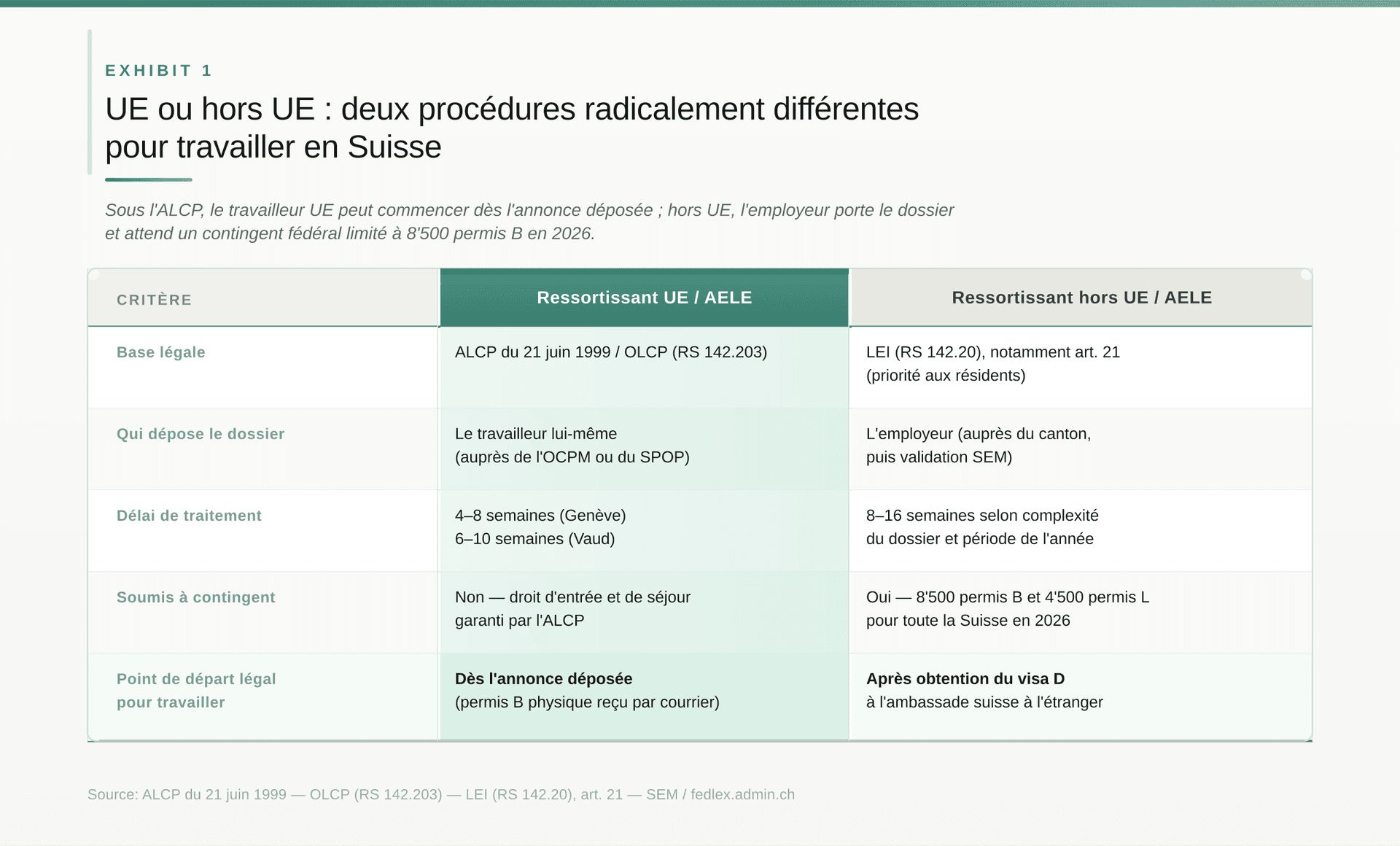
Comparative table: EU/EFTA National vs Non-EU/EFTA National across 5 criteria. Source: AFMP of 21 June 1999 — OLCP (RS 142.203) — LEI (RS 142.20)
Work Permits in Switzerland 2026: Types, Timelines and Procedures — EU or non-EU: two radically different procedures for working in Switzerland

Permit B or Permit C: which one matches your contract?

The type of permit follows directly from the duration of your employment contract and your length of stay in Switzerland, not from your nationality.
The Permit L (short-term authorisation) covers contracts of less than 12 months. It is issued in the holder's name, tied to a specific employer, and must be renewed with each change of assignment.
The Permit B (annual residence authorisation) applies to contracts of one year or more, or to open-ended contracts. It is renewable each year and, under the AFMP, becomes multi-year from the first renewal if you are an EU national. Outside the EU/EFTA, it is subject to federal quotas set by the State Secretariat for Migration (SEM).
The Permit C (establishment authorisation) is obtained after 5 years of continuous residence for EU/EFTA nationals and certain third-country nationals covered by bilateral agreements, or after 10 years for others. This permit is not tied to employment: it allows you to change employer, canton or occupation without revalidating your authorisation. To understand the transition from Permit B to Permit C, please refer to our article on how to obtain permanent residence in Switzerland.
Practical rule: if your contract is open-ended, apply directly for Permit B. Do not apply for a Permit L in the hope of converting it easily — the change-of-status procedure adds 4 to 10 weeks of processing time depending on the canton.

EU Nationals: concrete formalities for working in Switzerland

You are French, Belgian or a national of any other EU/EFTA member state: the AFMP of 21 June 1999 grants you the right to enter and reside in Switzerland in order to pursue a gainful activity. The work authorisation is not a discretionary permission — it is a registration formality.
Concretely, here is what you must do within 14 days of your arrival in Geneva:
  • Present yourself at the OCPM (Office cantonal de la population et des migrations) with your employment contract, a valid identity document and proof of address.
  • Submit the arrival notification form (available at ge.ch/population).
  • Pay the cantonal fee: approximately CHF 65 for a Permit B in Geneva.
In Vaud, the same application is submitted to the SPOP (Service de la population). The processing time is 6 to 10 weeks, compared with 4 to 8 weeks in Geneva — do not plan your first working day on the assumption that the physical permit will be immediately available. You may legally begin working as soon as the notification has been submitted; the permit will arrive by post.
A French national with an open-ended contract who fails to submit their notification within 14 days is liable to a cantonal fine and will see their Permit B delayed by the same amount of time. This deadline is set by the Ordinance on the Introduction of Free Movement of Persons (OLCP, RS 142.203).
If you are arriving with your family, please consult our article on Swiss permits for foreign nationals for the family reunification procedures.

Non-EU/EFTA Nationals: how to obtain a permit subject to quotas?

You are a national of a non-EU/EFTA country — American, Canadian, Brazilian, Moroccan, Filipino: your access to the Swiss labour market is governed by the Foreign Nationals and Integration Act (LEI [Loi sur les étrangers et l'intégration], RS 142.20) and the annual federal quotas.
The 2026 federal quota caps the number of Permit B authorisations at 8,500 and Permit L authorisations at 4,500 for Switzerland as a whole: your employer must demonstrate to the SEM that no local or European candidate was available before submitting the application, in accordance with Article 21 LEI (priority to residents).
The procedure takes place in two stages:
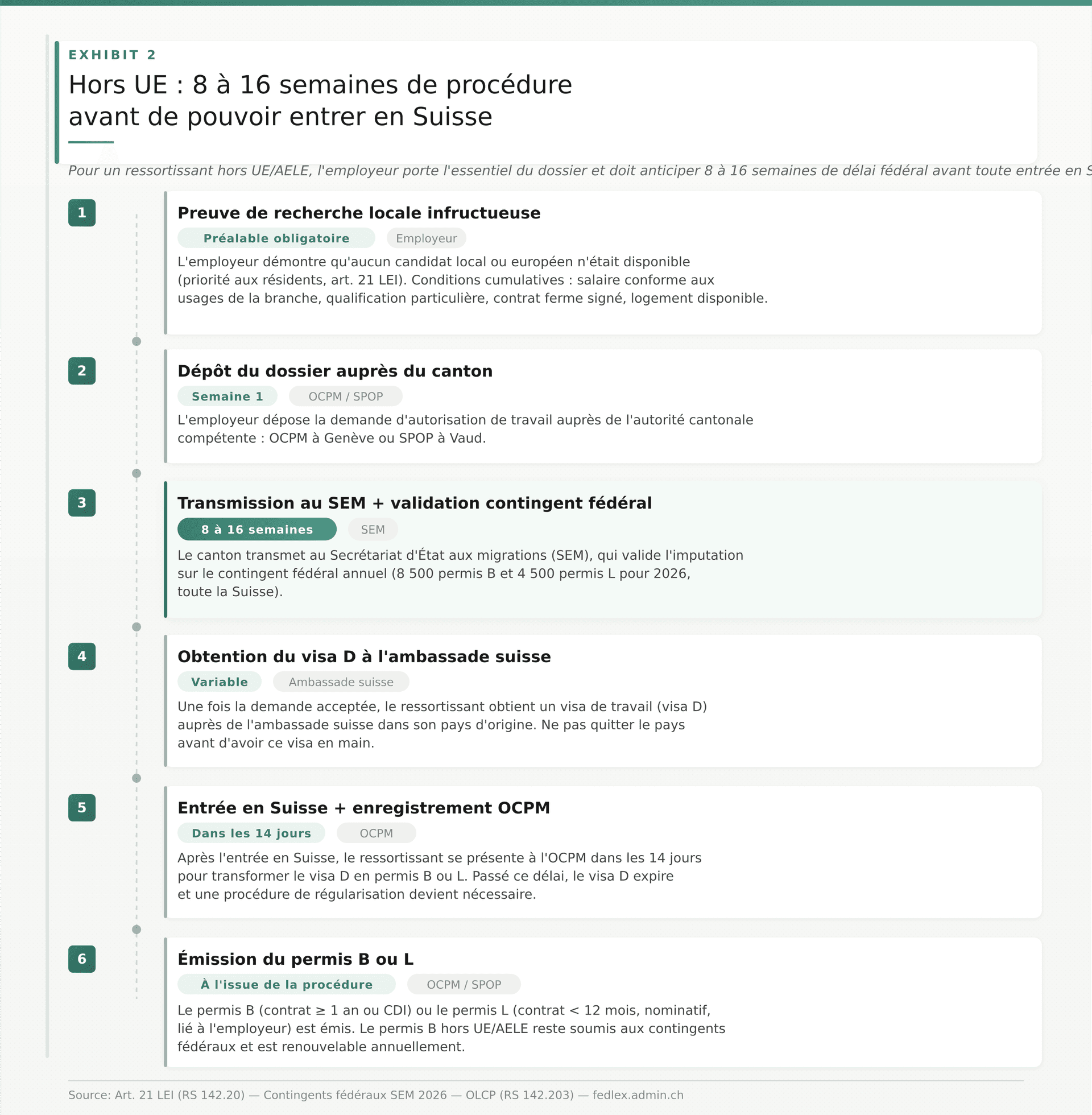
1. Your employer submits a work authorisation application to the competent cantonal authority (OCPM in Geneva, SPOP in Vaud), with evidence of prior recruitment efforts for local candidates. 2. The canton forwards the application to the SEM, which validates the allocation against the federal quota. This processing time is 8 to 16 weeks depending on the complexity of the case and the time of year.
Several cumulative conditions are required:
  • Salary in line with industry standards (no wage dumping)
  • Specific qualifications justifying the recruitment of a non-EU profile
  • Firm signed employment contract
  • Available accommodation at the time of entry
If your application is accepted, you will obtain a work visa (D visa) from the Swiss embassy in your country of residence, and then regularise your permit upon arrival in Switzerland. Do not leave your country of origin before you have this visa in hand.
Process diagram: 6 steps. Source: Art. 21 LEI (RS 142.20) — SEM Federal Quotas 2026 — OLCP (RS 142.203) — fedlex.admin.ch
Work Permits in Switzerland 2026: Types, Timelines and Procedures — Non-EU: 8 to 16 weeks of procedure before being able to enter Switzerland

Entry form and arrival notification: what are the deadlines?

The Swiss entry form and the arrival notification are two separate procedures that many people confuse.
The arrival notification at the commune is compulsory for all residents, regardless of nationality, within 8 working days of taking up residence (Geneva cantonal regulation). It is submitted to the communal administration, not to the OCPM.
Registration with the OCPM (for the residence permit) follows, with the complete supporting documents. The legal deadline for EU nationals is 14 days, as indicated above.
For non-EU/EFTA nationals entering on a D visa: you must present yourself at the OCPM within 14 days of entering Switzerland to convert the visa into a Permit B or L. After this deadline, your D visa expires and a regularisation procedure becomes necessary — this is avoidable with proper calendar management.
Documents to prepare before your OCPM appointment:
  • Valid passport (still valid for at least 6 months)
  • Employment contract or confirmation of employment
  • Signed tenancy agreement or proof of accommodation
  • Identity photographs in Swiss format (35x45 mm)
  • Completed form available at ge.ch/population
Appointments at the OCPM Geneva are booked online and are often available with a 3 to 5 week wait. Book your appointment as soon as you sign your contract.

Change of employer, promotion or unemployment: what happens to your?

Your professional situation changes during your stay: here are the practical rules for each case.
Change of employer under Permit B, less than 12 months of residence (EU national): in principle free under the AFMP, but Geneva and Vaud require notification to the OCPM or SPOP within 8 days. Allow 3 to 8 weeks for the administrative update depending on the canton.
Change of employer under Permit B, non-EU: the work authorisation must be revalidated by the canton. The new employer must submit a fresh application. Processing time: 6 to 12 weeks. Do not leave your current post before written validation has been received.
Promotion involving a significant change of role: if your new role falls outside the scope of the initial authorisation (for example, moving from a technical position to a management role with extended responsibilities), an update to your work authorisation may be required by the OCPM. Check with your HR department.
Unemployment under Permit B (EU national): the AFMP protects your right to remain for 6 months if you have worked for more than 12 months in Switzerland, provided you register with the Regional Employment Office (ORP [Office régional de placement]) within 7 days of the end of your contract. With less than 12 months of work, the right to remain may be limited to the duration of unemployment benefits.
Unemployment under Permit B, non-EU: the permit is not automatically renewed at the end of its validity if you are not in employment. The SEM may decline to renew the authorisation. Plan ahead with your employer or seek legal advice.

Cross-border commuter, seasonal worker or self-employed: which?

Three common situations each warrant a distinct answer.
The cross-border commuter (Permit G): you reside in France, Germany or Italy within the border zone and work in Switzerland. Permit G is issued by the canton of employment (not of residence) upon presentation of an employment contract and proof of address in the border zone (defined by bilateral agreement, generally within 20 km of the border for neighbouring France). Permit G is valid for 5 years under the AFMP for open-ended contracts and is renewable. You must return to your place of residence at least once a week. The application is submitted to the OCPM for Geneva or the SPOP for Vaud; processing time: 4 to 8 weeks.
Seasonal work: the seasonal permit as such has not existed since 2002. Seasonal workers (agriculture, tourism, construction) use either Permit L for a duration of 4 to 12 months, or Permit B for longer contracts. Employers in Geneva's agricultural sector are familiar with this procedure via the OFT form.
The self-employed (non-salaried worker): as an EU national, you may pursue a self-employed activity in Switzerland under Permit B, provided you can demonstrate genuine economic activity (business plan, proof of clients, tax declaration). The OCPM generally requires evidence of start-up capital or sufficient projected income. For non-EU/EFTA nationals, access to self-employed status is even more restrictive and requires specific authorisation from the SEM.
For a comparison of cantonal arrangements between Geneva and other destinations, our article on Swiss permits for foreign nationals details the particularities by canton of residence.

Conclusion

Your Swiss work permit application depends on details that change everything: nationality, contract duration, canton of establishment. An error in category or a missed deadline extends processing times by 4 to 16 weeks. Have your situation reviewed by a relocation specialist before signing your lease or leaving your current employer.
"The information contained in this article is provided for informational purposes only and does not constitute legal advice. For any personal situation relating to work permits in Switzerland, please consult a qualified professional or the competent authorities."

FAQ

For a French national with an open-ended contract, Permit B is issued following the arrival notification submitted to the OCPM within 14 days. The physical permit arrives by post within 4 to 8 weeks in Geneva, and 6 to 10 weeks in Vaud. You may begin working as soon as the notification has been submitted.