Whatsapp logo

Blog

Moving to Switzerland with Pets: 2026 Requirements & Tips

Moving to Switzerland with pets in 2026? Get the latest import rules, vaccine timelines, costs, and settling-in tips for dogs and cats.

Particulier
Blog Relocation Genevoise Image

Can You Bring Your Pet to Switzerland?

Yes. Switzerland follows EU-aligned pet import rules. Dogs, cats, and ferrets need three things:
  • An ISO microchip
  • A valid rabies vaccination
  • The right travel document
  • No quarantine for most countries.
If you're moving to Switzerland with pets, you're in good company. Around 40% of Swiss households own a cat or dog, so the country is well set up to welcome your four-legged family member. The process is clear if you follow the steps in the right order.
Three things every pet needs, no matter where you're moving from:
  1. ISO-compliant microchip (15-digit, implanted first)
  2. Rabies vaccination (given after the chip)
  3. The right travel document (passport or health certificate, depending on your origin country)
The good news? Switzerland requires no quarantine when you meet these rules. This is a major difference from destinations like Australia or Japan, where quarantine can last weeks. The Swiss Federal Food Safety and Veterinary Office (FSVO) sets the rules, aligned closely with EU regulations.

Requirements for Pet Import into Switzerland (as of 2026)

Every dog, cat, or ferret entering Switzerland needs a 15-digit ISO microchip, a rabies vaccine given after the chip, and either an EU pet passport or an EU health certificate.

Microchip First, Rabies Vaccine Second

Your pet must have an ISO 11784/11785-compliant 15-digit microchip before getting the rabies vaccine. If the vaccination happens before the chip, it legally does not count. You restart the waiting period from scratch. If your pet already has a non-ISO chip, you have two options: carry your own compatible scanner, or have a second ISO-compliant chip implanted alongside the existing one.

Rabies Vaccination and the 21-Day Rule

The first rabies shot can only be given from 12 weeks of age. After that first shot, a 21-day waiting period begins before your pet can legally enter Switzerland. This means puppies and kittens under roughly 16 weeks generally cannot make the trip. For boosters — as long as they are given before the previous vaccine expires — there is no new 21-day wait. Keep those vet records current.

Required Travel Documents

  1. EU pet passport: the standard document for pets of EU or EEA residents, valid for the pet's lifetime.
  2. Non-commercial EU health certificate: required for pets coming from outside the EU. Valid for 10 days from issue for entry into Switzerland, then extended to 4 months for onward EU travel.

New EU Certificate

New EU certificate formats under Regulation (EU) 2026/131 took effect in April 2026 for non-commercial movements. A transition period is in place, but always download the current form from official sources before booking your flight. Check the FSVO website for the latest templates.

Do the Rules Change Depending on Where You're Moving From?

Yes. Switzerland sorts origin countries into three groups, including EU/EEA, listed third countries (like the US, UK, Canada, and Japan), and unlisted countries. The paperwork gets heavier as you go down the list.

Moving from the EU or EEA

This is the simplest route. Your EU pet passport covers everything. No additional tests or certificates are needed. If your passport is up to date with current vaccinations, you're ready to travel.

Moving from a Listed Country (US, UK, Canada, and Others)

Listed countries have a favourable rabies status recognized by Switzerland. You'll need an EU health certificate, endorsed by your country's official veterinary authority.
  • For the USA, that means USDA/APHIS endorsement.
  • For the UK, you now need an Animal Health Certificate. The UK pet passports are no longer accepted post-Brexit.
  • For Canada, Japan, and Australia, you need equivalent national authority endorsements. The certificate must be signed by an accredited vet and officially stamped. Give yourself at least 4–6 weeks to get the appointment and endorsement before your move date.

Moving from an Unlisted Country

If your origin country is not on the EU's favourable rabies status list, the process is longer. There are 4 steps for the whole process:
  • Step 1: Must microchip and vaccinate your pet, and wait 30 days.
  • Step 2: Complete a rabies antibody titre test at an EU-approved laboratory.
  • Step 3: Wait 3 months after the test before your pet can enter Switzerland
  • Step 4: Get your EU health certificate.

Practical advice

Plan for at least 4–5 months of preparation if you're moving from an unlisted country.
As of June 2026, Serbia and Montenegro moved to the 'favourable rabies status' group, meaning their pets now follow the listed-country route. Rules evolve. Always verify your origin country's status using the FSVO entry check tool before booking.
A maximum of 5 pets per person can be imported as non-commercial pets. Your pet must travel with you or arrive within 5 days of your own journey.
EU/EEA
Documents neededEU pet passport
Extra testsNone
Waiting timeNone
Listed third country (US, UK, Canada…)
Documents neededEU health certificate + authority endorsement
Extra testsNone
Waiting time21-day post-vaccine wait
Unlisted country
Documents neededEU health certificate + titre test results
Extra testsRabies antibody titre test
Waiting time3 months post-titre test
Pet import requirements by origin country

An Ultimate Guide for You to Fly a Pet into Switzerland

Most pets arrive in Switzerland through Zurich Airport (ZRH) or Geneva Airport (GVA). Depending on your pet's size and your airline's policy, they can travel:
  • In the cabin (for small pets)
  • As checked baggage
  • As manifested cargo in an IATA-approved crate

Cabin Travel

Cabin travel is generally available for small pets weighing up to 8 kg (including the carrier).
Before booking, keep in mind:
  • Airline policies vary significantly.
  • Some airlines prohibit pets in the cabin on long-haul flights.
  • Seasonal restrictions, such as summer embargoes, may also apply.

Pro Tip

Contact your airline 3–4 months before departure to confirm eligibility and reserve your pet's space, as cabin pet spots are often limited.

Cargo Travel

For larger dogs, cargo travel is usually the only available option.
Pets travel in a temperature-controlled aircraft hold as either:
  • Accompanied excess baggage, or
  • Manifested air cargo.
The cost typically ranges from CHF 300 to over CHF 1,500, depending on:
  • Crate size
  • Flight route
  • Airline
  • Pet's weight

IATA Crate Requirements

Your pet's travel crate must meet IATA standards.
The crate should allow your pet to:
  • Stand upright without touching the roof
  • Turn around comfortably
  • Lie down in a natural position
Additionally:
  • Ventilation is required on at least three sides.
  • The door must be metal and equipped with a secure locking mechanism.
  • Soft-sided carriers are not permitted for cargo transport.

Important Reminder

Using the correct crate helps ensure your pet's safety and avoids boarding issues at the airport.

Should You Sedate Your Pet?

Most veterinarians and airlines strongly advise against sedating pets before flying.
Sedation can:
  • Affect your pet's balance during the flight
  • Reduce its ability to regulate body temperature at altitude
  • Increase health risks while traveling
Some airlines may even invalidate your pet's health certificate if sedation is recorded.

Customs Clearance in Switzerland

When you arrive, keep all original documents with you or attached to your pet's travel paperwork—not inside checked luggage.
These documents include:
  • Health certificate
  • Rabies vaccination records
  • Microchip information

Important Note

For pets arriving as cargo, customs clearance at Swiss airports typically takes 4–6 hours, so plan your onward travel accordingly.

Restrictions on Dog Breeds

Switzerland has no nationwide breed ban, but each canton sets its own rules. Geneva is one of the strictest.
In Geneva, pit bull-type dogs (including American Pit Bull Terriers and Staffordshire Bull Terriers) are either banned outright or require a specific permit. Getting that permit means proving a legitimate need, having a clean criminal record, and passing a behavior assessment for both dog and owner.
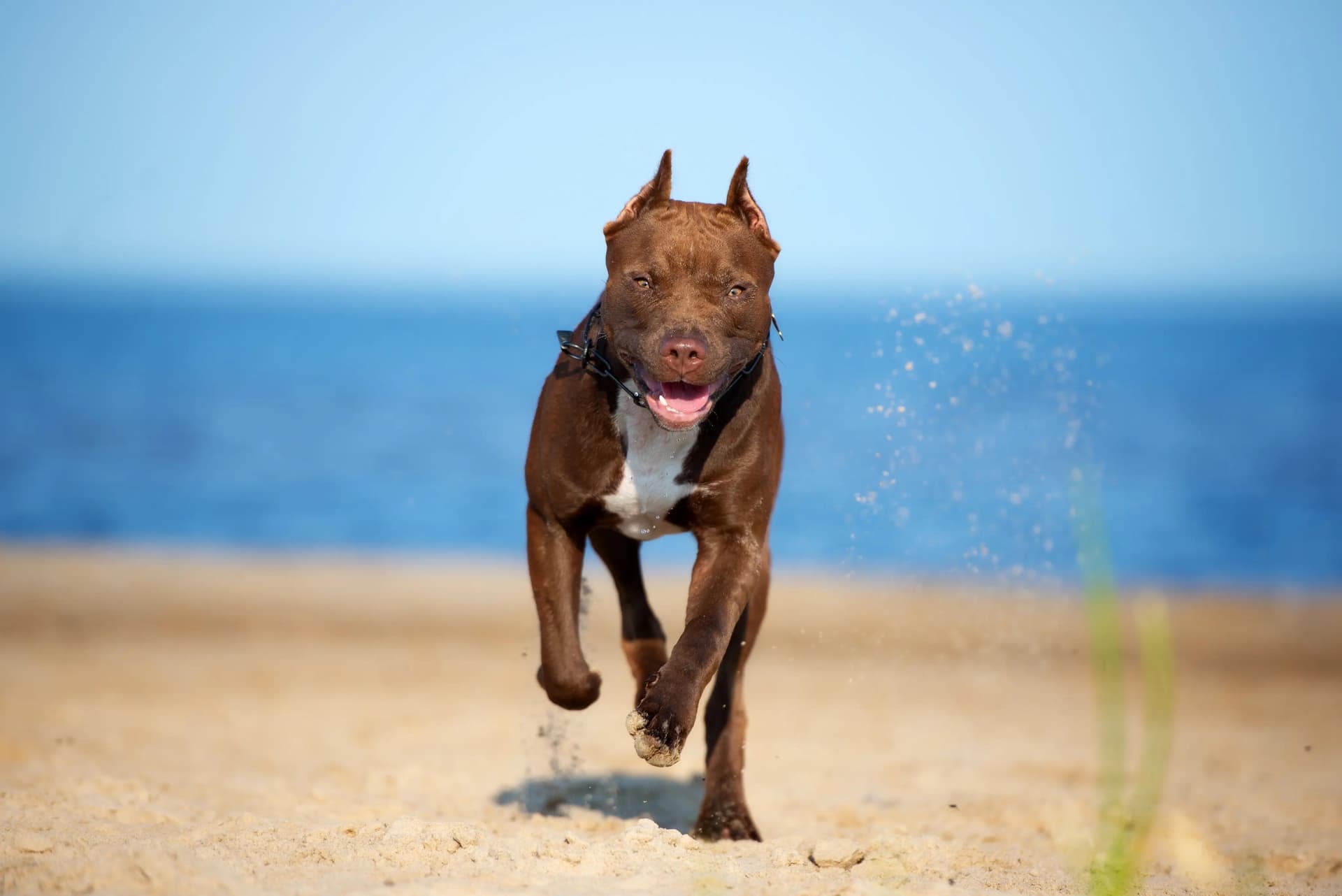
American Pit Bull Terrier dog running on the beach

Other cantons have their own restricted breed lists:
  • In Valais, several large mastiff-type breeds require a permit.
  • Zurich bans the American Pit Bull Terrier and breeds with similar physical characteristics.
  • Fribourg operates a separate cantonal list.
Nationwide ban for all cantons:
  • Dogs with cropped ears or docked tails cannot be imported into Switzerland.
  • Limited exceptions exist for owners relocating permanently with a pre-existing permit, but these are rare and must be secured before travel.

Practical Advice

Before you sign a lease, check the breed regulations for your destination canton. Moving one canton over can sometimes eliminate a permit requirement. That is worth knowing before you commit.
Always verify the current list directly with cantonal authorities or via the FSVO database, as restrictions are updated periodically.

What Should You Do After Arriving with Your Pet?

Within 10 days of arrival, dog owners must register with a Swiss vet in the AMICUS database — and that is just step one of settling in.

Dog Registration, AMICUS, and the Dog Tax

Switzerland runs a national dog registry called AMICUS. Within 10 days of arriving, you must book a vet appointment to register your dog, then register with your commune. Annual dog tax varies significantly: expect to pay roughly CHF 50 to CHF 200 per year, depending on where you live. In Geneva specifically, dog owners are also required to carry civil liability insurance covering their dog. This covers damage your dog might cause to third parties. Several Swiss insurers offer affordable pet liability policies alongside household insurance.

Getting a Swiss or EU Pet Passport

Your non-EU health certificate covers travel within the EU and EEA for 4 months after issue. After that, visit a Swiss vet to get your pet a proper EU pet passport. This is what you will need for weekend trips to France, Italy, or Germany — and it makes border crossings effortless.

Swiss Animal Welfare Rules Expats Do Not Expect

Switzerland takes animal welfare seriously, and some rules surprise first-time expat pet owners. Social species must be kept in pairs: guinea pigs, rabbits, and parrots must have at least one companion under the Swiss Animal Welfare Act — keeping them alone is illegal. Most public green spaces and tram areas in Geneva require dogs to be leashed. Mountain hiking trails often have their own rules during nesting season. Switzerland also has strict laws against pet abandonment, with heavy fines for violations.
For finding a vet, ask your commune or landlord for local recommendations. English-speaking vets are common in Geneva and Zurich. Pet insurance is not mandatory but worth considering — Swiss vet costs are high even by European standards, with standard consultations running CHF 100–250 or more. If you need settling-in support to navigate these first steps, settling-in support, working with a local relocation specialist can help you get everything in order quickly.

How Do You Find Pet-Friendly Housing in Switzerland?

Swiss landlords cannot ban small pets like hamsters or fish, but dogs and cats usually need written landlord consent. In tight markets like Geneva, that consent is a competitive edge you have to plan for.
Geneva's rental vacancy rate sits well below 1%, making it one of the most competitive markets in Europe. Landlords have the upper hand, and a household with a large dog can face immediate rejection. Here is how to improve your odds:

Understanding How Pet Clauses Work

Most Swiss rental contracts include a clause requiring a written consent from the landlord before keeping a dog or cat. Here are some tips:
  1. Ask first and get the consent clause in writing. Never assume it is fine and discover otherwise later.
  2. Strengthen your Swiss rental application file as a pet owner:
  • Write a short pet CV covering breed, age, weight, vaccination record, and temperament.
  • Include references from your previous landlord confirming no pet-related damage.
  • Attach proof of civil liability insurance covering your pet. Show that you are a responsible, long-term tenant.

Find Pet-Friendly Neighborhoods and Properties

Neighborhoods and housing types matter. Ground-floor apartments with direct garden access, properties near parks, and suburban communes outside the city center are more dog-friendly. Choosing the right neighborhood in Geneva makes a real difference for pet-owning families.
Don’t know how to find an apartment in Geneva? Check out our guide.

How Much Does Moving to Switzerland with Pets Cost?

Budget anywhere from a few hundred francs for a short EU road move to CHF 2,000–6,000 or more for an intercontinental door-to-door pet relocation.
Key cost line items to budget for:
ISO microchip implant
CHF 150–400CHF 50–100
Health certificate and endorsement
CHF 150–400CHF 100–500
Rabies antibody titre test (if needed)
CHF 150–400CHF 200–400
IATA-approved travel crate
CHF 150–400CHF 80–500
Airline in-cabin pet fee
CHF 150–400CHF 50–150 per flight
Cargo or freight pet transport
CHF 150–400CHF 300–1,500+
Professional pet relocation service
CHF 150–400CHF 1,000–4,000+
Cost of items
Post-arrival costs to factor in:
Annual dog tax
CHF 80–150CHF 50–200 per year
Civil liability insurance
CHF 80–150CHF 50–150 per year
Pet insurance (optional but recommended)
CHF 80–150CHF 300–800 per year
Post-arrival costs
Saving tips:
  • Book your endorsement appointment early. Last-minute slots add cost and stress. Right-size your IATA crate: a crate that is too large adds dead-weight fees, while one that is too small fails inspection.
  • Avoid rebooking during summer embargoes, which can add hundreds of dollars in fees.
For a full breakdown of relocation costs, see our guide on the full cost of moving to Switzerland.

FAQ

No — not if your pet's microchip, rabies vaccination, and travel documents are all in order. Pets that fail document checks at the Swiss border risk being returned to the country of origin or placed in quarantine at the owner's expense. Getting the paperwork right before you fly is non-negotiable. Work with an accredited vet who is familiar with Swiss import rules, and double-check every document against the FSVO checklist at least 2 weeks before your travel date.

Moving with Your Pet: Next Steps

Moving to Switzerland with your pet is easier when you follow the right order: microchip → rabies vaccination → 21-day waiting period → paperwork. Depending on where you're moving from, the process can take anywhere from a few weeks to more than four months.
Once you arrive, there are still a few important steps, including AMICUS registration, dog tax, canton-specific regulations, and Switzerland's animal welfare requirements.
And don't forget one of the biggest challenges: finding a pet-friendly home, especially in Geneva's competitive rental market.

Plan to Move to Switzerland with Pets?

Relocation Genevoise handles the housing search, landlord negotiations, and settling-in admin so you and your four-legged family can feel at home from day one.

Author image

Louis-Marie Tortiello

[email protected]