Whatsapp logo

Blog

How to Find an Apartment in Geneva, Switzerland in 2026

Learn how to find an apartment in Geneva, Switzerland, from rental search tips to documents, costs, and relocation support.

Particulier
Professionelles
Blog Relocation Genevoise Image

Introduction

Finding an apartment in Geneva takes longer than most people expect. The city is one of the most competitive rental markets in Europe, and newcomers who arrive without a plan often spend weeks — sometimes months — searching without success.
Geneva is home to the United Nations, the World Health Organization, and dozens of international finance and NGO headquarters. That concentration of international professionals, cross-border workers, and expat families creates enormous demand for housing, in a city where supply is tightly constrained.
Newcomers typically struggle with four things: understanding local rental rules, gathering the right documents, choosing the right neighborhood, and moving fast enough when a good listing appears.
This step-by-step guide covers everything you need to know about renting an apartment in Geneva, Switzerland — from setting a realistic budget to signing a Swiss lease.
0.34%

Geneva vacancy rate

14 days

Avg. listing time

3–6 months

Recommended search

Step 1: Understand the Geneva Rental Market

Geneva's rental market is one of the tightest in Switzerland. The city's vacancy rate sits at just 0.34% — roughly three times lower than the Swiss national average. Demand is consistently high, driven by international organizations, the finance sector, and a large cross-border workforce. For a full breakdown of current Geneva apartment prices in 2026, see our dedicated pricing guide.
Apartments near the city center, international organizations, international schools, and major public transport hubs attract the most applicants. Properties in these areas are often listed and taken within days — sometimes hours.
Unlike many European cities, most Geneva residents rent rather than own. This means the rental market is large and active — but also highly competitive. A well-priced apartment in a good location rarely stays available for more than two weeks.

The Key Takeaway

Start your Geneva apartment search early, ideally three to six months before your move date, and have your rental dossier ready before you begin visiting properties. Waiting until you arrive to start searching puts you at a serious disadvantage.

Step 2: Set a Realistic Budget before You Search

Rent is only part of your monthly housing cost in Geneva. Before you start your search, you need a clear picture of your total housing budget and the cost of living in Geneva. Here are the key housing-related costs to factor in:
Monthly rent
What it coversBase rent for the apartment
When to payMonthly
Building charges
What it coversHeating, hot water, common areas
When to payMonthly (often included)
Utilities
What it coversElectricity, internet, phone
When to payMonthly
Household insurance (RC)
What it coversLiability and contents insurance
When to payAnnual or monthly
Parking
What it coversGarage or outdoor space
When to payMonthly (if applicable)
Rental deposit (caution)
What it coversTypically 2–3 months' rent
When to payOne-time, at lease signing
Monthly housing costs in Geneva
Swiss landlords and property management agencies expect tenants to have a stable, verifiable income.

A Common Rule of Thumb

Your gross monthly income should be at least three times your monthly rent. Some landlords apply a stricter ratio, especially for higher-priced apartments.
If you're relocating through an employer, check whether your package includes a housing allowance or temporary accommodation support. Many international organizations and multinationals in Geneva offer this as part of their expat relocation package.

Plan your housing budget with local guidance

Before starting your Geneva apartment search, Relocation Genevoise can help you define a realistic housing budget based on your lifestyle, work location, and family needs.

Step 3: Choose the Right Geneva Neighborhood

There is no single "best" neighborhood in Geneva. The right area depends on your work location, family situation, school needs, budget, and lifestyle. Here's a practical overview of Geneva neighborhoods:
  • Central Geneva (Eaux-Vives, Plainpalais, Champel): Convenient for work, restaurants, and transport. High demand, higher rents, smaller apartments. Best for professionals without children or couples who prioritize walkability.
  • Carouge: A charming, village-like neighborhood just south of the city center. Popular with young professionals and families. Good mix of cafés, markets, and green spaces. Slightly more affordable than central Geneva.
  • Lancy, Onex, Vernier, Meyrin: Residential areas outside the city center offering more space, quieter streets, and better value for money. Good public transport links. Ideal for families, those with cars, or anyone prioritizing space over proximity.
  • International school zones: If you have school-age children, proximity to international schools is often a priority. These areas tend to be competitive and pricier.

The Key Trade-offs to Weigh

Commute time, school access, apartment size, lifestyle fit, budget, and rental availability. Narrowing your search to two or three neighborhoods — rather than searching everywhere — makes your Geneva apartment search more focused and effective.

Step 4: Search on the Right Platforms

In Geneva's fast-moving housing market, where you search matters as much as how quickly you respond. Good apartments move fast — often within 24 to 48 hours of being listed. Relying on a single platform is not enough.

Where to search for apartments in Geneva

Swiss property portals: Homegate, ImmoScout24, Comparis, and Anibis are the main platforms. Set up alerts for your criteria so you're notified the moment a new listing appears.
Régie (property management agency) websites: Many Geneva landlords manage their properties through local régies. Check agency websites directly — some listings never appear on the main portals.
Employer and expat networks: Many international organizations and multinationals maintain internal housing boards or can connect you with colleagues who are leaving. These off-market opportunities are often the fastest route to a good apartment.
Relocation networks: Local relocation specialists often have access to listings before they go public, and can match you with properties that fit your profile.
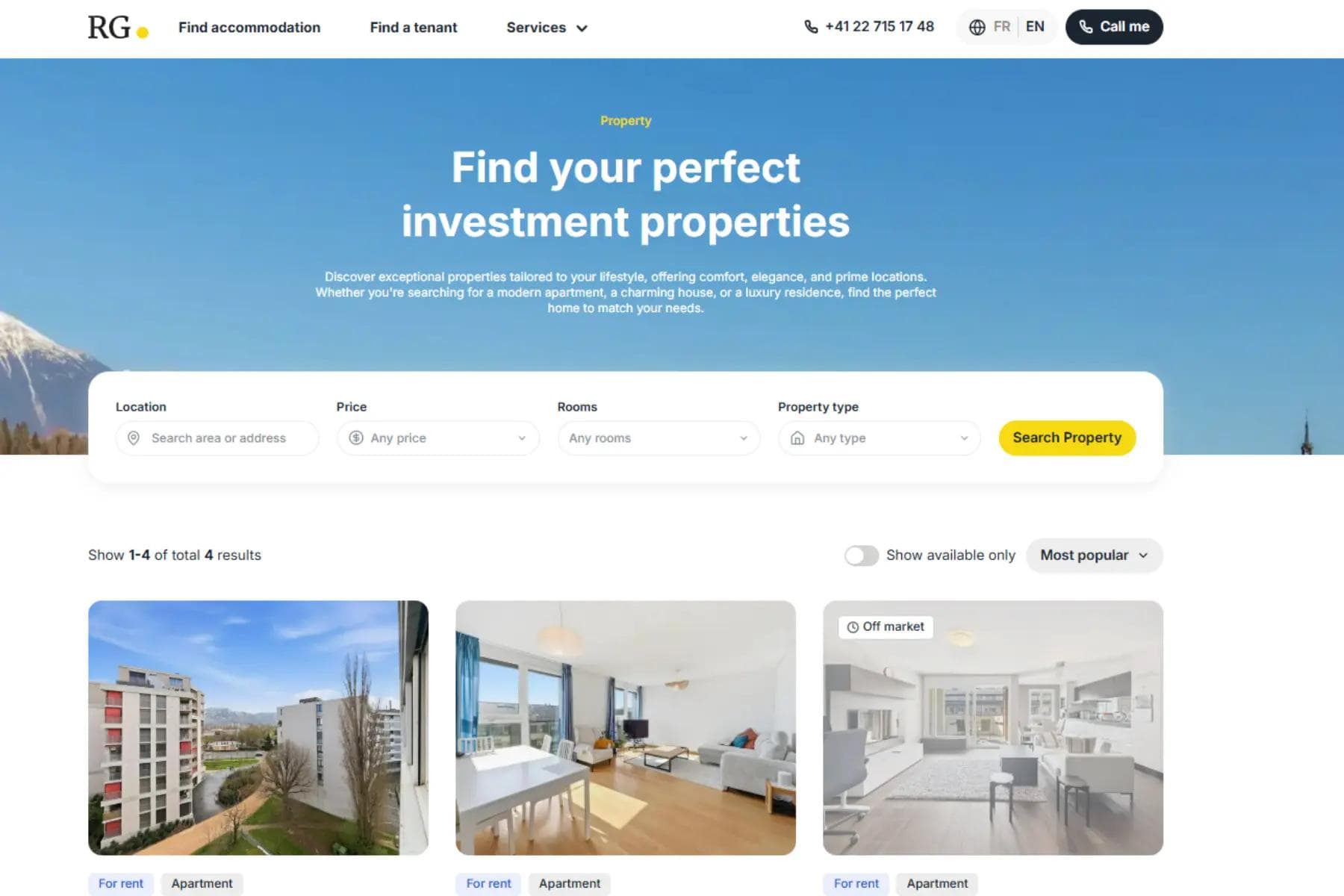
Check reliable property listing sites daily, such as Relocation Genevoise’s property listings, and respond immediately when something matches your criteria. Be cautious of scams: never transfer money before visiting an apartment and signing a formal contract. If a landlord asks for payment before a viewing, treat it as a red flag.
Relocation Genevoise's property listing site


Step 5: Prepare a Strong Rental Application Dossier

Finding an apartment is step one. Securing it depends entirely on your application. In Geneva's competitive rental market, landlords and régies receive multiple applications for every listing. A complete, well-organized dossier helps them review your file faster — and choose you over less-prepared candidates.

Required Documents for Renting in Geneva

  • Valid ID or passport
  • Swiss residence permit (or proof of pending application)
  • Last three payslips or employment contract
  • Debt collection extract (extrait du registre des poursuites) — no more than three months old
  • Proof of current address
  • Completed rental application form (provided by the régie)

How Can Expats Make Their Dossier Stronger?

Expats need to explain their employment situation, permit status, and relocation timeline clearly. A short cover letter in French explaining who you are, your employer, and your move date can make a real difference. If your permit is pending, include a letter from your employer confirming your contract.

Pro Tip: Get help with Your Rental Dossier

Relocation Genevoise can help prepare and submit a complete rental dossier in Geneva, reducing delays and improving your chances in a competitive market.

Step 6: Inspect apartments and Ask the Right Questions

Apartment viewings in Geneva can be individual or group visits. Either way, arrive on time, bring key documents from your dossier, and be ready to submit your application the same day. Take photos and notes during the visit, respecting any rules set by the régie.

Questions to Ask During an Apartment Visit

  • What are the monthly charges (chauffage, eau chaude, entretien)?
  • What is the heating system and who pays for it?
  • When is the earliest possible lease start date?
  • What is included — appliances, storage, parking?
  • Are there any planned renovations or building works?
  • What are the building rules (noise, pets, guests)?
  • Is there an inventory list, and what is the condition of the furniture? (for furnished apartments)
If you are relocating from abroad and cannot visit apartments in person, the local team from Relocation Genevoise can support you on the ground with its end-to-end accommodation finding services in Geneva. We can attend viewings on your behalf, assess each property, and share clear feedback so you can make an informed decision from a distance.

Step 7: Understand the Swiss Rental Contract

Your rental contract (bail à loyer) defines the terms of your tenancy. Read it carefully before signing. Key elements include the monthly rent, additional charges, lease start date, notice period, deposit amount, and house rules.

What to check in a Geneva lease

Monthly rent and any planned rent adjustments
Additional charges (charges) — fixed or estimated
Lease start date and initial lease duration
Notice period (typically three months in Switzerland)
Deposit amount and the blocked account details
Building rules (règlement de maison) — noise, pets, guests, waste
Parking and storage space allocation
Handover conditions and move-in inspection report (état des lieux)
Rental deposits in Switzerland are typically two to three months' rent, placed in a blocked bank account (compte bloqué) in the tenant's name. The deposit is released when you leave, provided the apartment is returned in good condition.
The move-in inspection report (état des lieux d'entrée) is important. It records the condition of the apartment when you take possession. Review it carefully, note any existing damage, and keep a signed copy. This document protects you when you leave.

Legal note

Swiss tenancy rules are governed by federal law, including the Swiss Code of Obligations. Rental guarantees and lease obligations should be reviewed carefully before signing.

Step 8: Consider Temporary Housing While You Search

Many expats arrive in Geneva before securing a long-term apartment. Temporary housing gives you the time and flexibility to visit properties in person, assess neighborhoods, and submit a strong application — without the pressure of needing to sign immediately.
Options include serviced apartments, short-term furnished rentals, corporate housing, and extended-stay hotels. Temporary housing is typically more expensive per month than a long-term lease, but it removes the pressure of signing the wrong apartment in a rush.

When is temporary housing a smart choice?

You are moving from abroad and cannot visit apartments before arriving
You do not yet have a Swiss residence permit
Your employment contract starts soon and you need to be in Geneva quickly
You want to visit multiple neighborhoods before committing to one
You are relocating with children or pets and need more time to find the right fit
Families should consider school commute and transport access even for temporary stays — it helps you evaluate neighborhoods practically before committing to a long-term lease.

Avoid Common Mistakes When Renting in Geneva

Most guides focus on where to search for apartments in Geneva. Fewer cover the mistakes that cost people time, money, and good opportunities. Here are the most common ones to avoid:
  • Starting your search too late. Three to six months before your move date is the recommended lead time.
  • Applying with an incomplete dossier. Missing documents slow down your application and give landlords a reason to choose someone else.
  • Searching only in central neighborhoods. Limiting yourself to the city center reduces your options significantly. Residential areas outside the center often offer better value with good transport links.
  • Ignoring commute time. An apartment that looks affordable may cost you more in time and transport than a slightly pricier option closer to work.
  • Not checking extra charges. Always ask for a breakdown of charges (chauffage, eau chaude, entretien) before comparing rents.
  • Signing without reviewing the lease. Pressure to sign quickly is common. Take the time to read the contract and ask questions before committing.
  • Underestimating the time needed. Even well-prepared applicants can take four to eight weeks to secure an apartment in Geneva. Build this into your relocation timeline.

Red flags to watch for

  • Requests for money before a viewing or before signing a contract
  • No formal rental contract offered
  • Unclear or unverifiable landlord identity
  • Rent that is priced significantly below the market rate
  • Refusal to provide documentation or answer basic questions
  • Pressure to transfer money quickly via wire transfer or informal payment

Find your apartment in Geneva with local support

From shortlisting properties that match your needs to preparing your rental application, coordinating with agencies, reviewing the lease, and supporting you after move-in, we help make the housing process simpler and less stressful.

FAQ

Yes — Geneva has one of the tightest rental markets in Europe. The city's vacancy rate is just 0.34% as of 2026, and well-priced apartments are typically taken within 14 days of being listed. Success depends on starting your search early (three to six months before your move), having a complete rental dossier ready before you visit properties, and responding to listings immediately. Expats who arrive without preparation often spend months searching.

Conclusion

Finding an apartment in Geneva requires preparation, speed, and local knowledge. The strongest applicants know their budget, choose realistic neighborhoods, and have a complete application file ready before they start visiting properties.
Expats should take time to understand Swiss lease basics, deposit rules, and temporary housing options before they arrive. The Geneva rental market rewards those who are organized and move quickly — and it penalizes those who are not.
Local relocation support saves time and reduces stress. Relocating to Geneva? Contact us today to find the right apartment and settle in with confidence.
Author image

Louis-Marie Tortiello

[email protected]