What Is Divorce and Why Switzerland Handles It Differently
Divorce is the legal dissolution of a marriage by a court or other competent authority. Worldwide, the grounds, process, and consequences of divorce vary widely — from fault-based systems in some countries to purely no-fault frameworks in others.
This makes Switzerland one of the more straightforward jurisdictions for divorce in Europe — but that does not mean it is simple. The divorce process in Switzerland involves courts, legal agreements, and decisions on finances, property, pensions, and children. If you are an expat or a foreign national living in Geneva or elsewhere in Switzerland, understanding how Swiss divorce law works is essential before you take any steps.
The 3 Legal Grounds for Divorce in Switzerland
Under the Swiss Civil Code, there are three recognized grounds for divorce:
Divorce by mutual consent (joint petition) — Both spouses agree to divorce and submit a joint petition to the court. No separation period is required. The couple must also present a complete agreement covering all consequences of the divorce: asset division, pension fund splitting, child custody, and maintenance.
Divorce on unilateral petition — One spouse files for divorce without the other's agreement. This is only possible after at least two years of separation. Once that period has passed, the right to divorce is absolute — the other spouse cannot block it.
Divorce on serious grounds (Article 115) — In exceptional cases, such as domestic violence or other circumstances that make continuing the marriage unbearable, a spouse may file for divorce before the two-year separation period has elapsed.
It is worth noting that the same rules apply to same-sex marriages in Switzerland, which have been legally recognized since July 2022.
How the Divorce Process Works in Switzerland
All divorces in Switzerland must go through a cantonal court — specifically, the court in the canton where you or your spouse is domiciled. There is no administrative or online-only divorce process. A judge must validate the divorce and, where children or pensions are involved, review the terms carefully.
Step 1 — File a Petition
For a joint divorce, both spouses sign a written petition and submit it together with a full divorce agreement. For a unilateral divorce, one spouse files alone after two years of separation.
Step 2 — Court Review
The judge reviews the petition and the divorce agreement. They check that the agreement is clear, complete, and not manifestly unfair. For matters involving children and pension funds, the judge is not bound by what the parties have agreed — they can and will intervene if the child's best interests are not protected.
Step 3 — Hearing and Judgment
In most uncontested cases, a single hearing is sufficient. The court then issues the divorce judgment, which covers all agreed consequences. In contested cases — where spouses disagree on finances, property, or custody — the process can take significantly longer.
How Long Does a Divorce Take in Switzerland?
An uncontested divorce typically takes three to four months from filing to judgment. A contested divorce, where the parties dispute financial matters or child custody, can take one to several years depending on the complexity of the case and the canton.
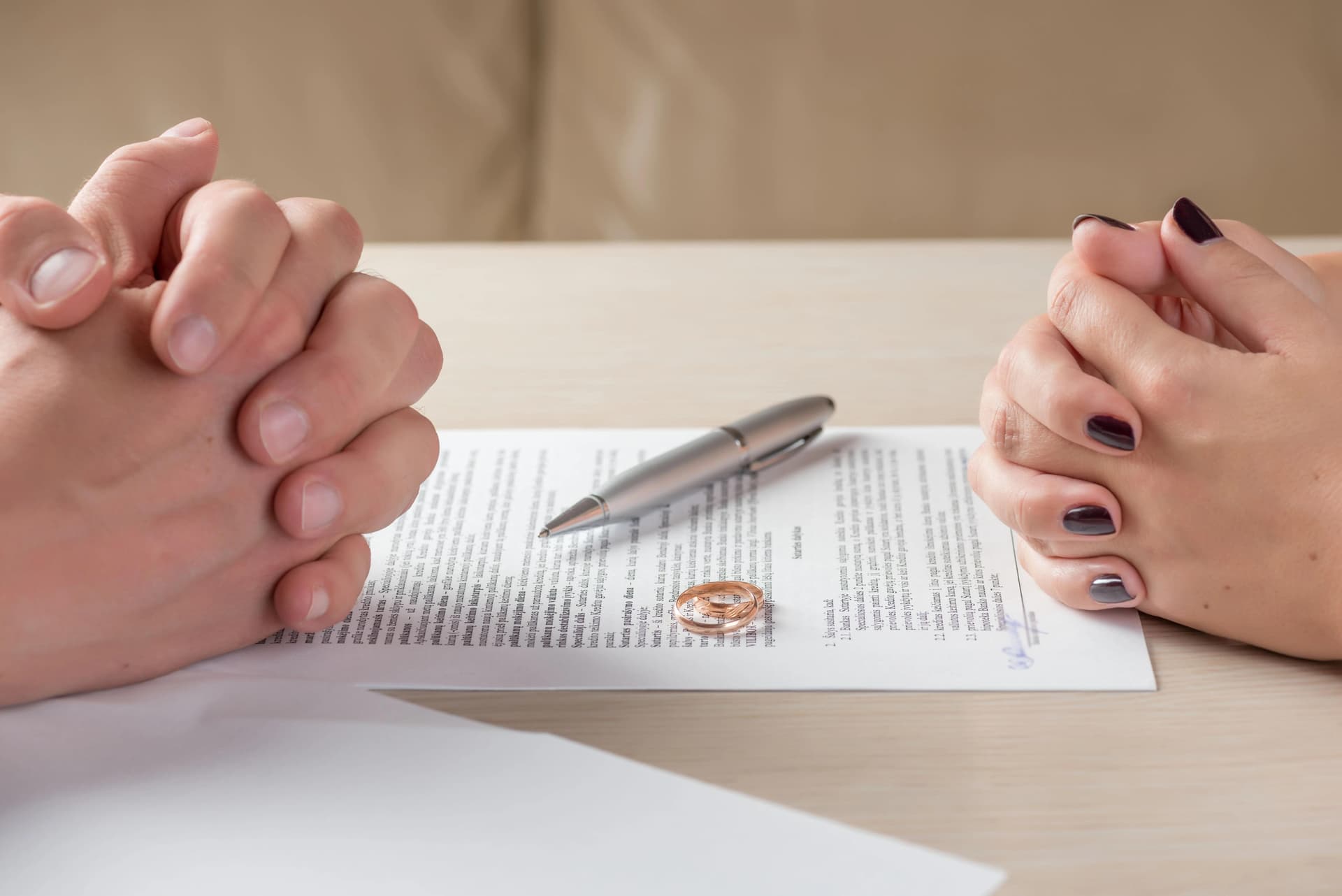
A married couple signed divorce documents.
Separation Requirements Before Filing
If you are filing for divorce without your spouse's agreement, Swiss law requires a minimum separation period of two years. This period begins from the date you stopped living together — not from any formal legal declaration. You do not need a court order to begin the separation period; you simply need to be able to prove the date cohabitation ended.
During the separation period, either spouse can apply to the court for interim measures — including temporary arrangements for child custody, maintenance payments, and the use of the family home. These measures are important for protecting both spouses and any children during what can be a difficult waiting period.
If both spouses agree to divorce, no separation period is required at all. This is one of the key advantages of a joint petition under Swiss divorce law.
Child Custody in Switzerland: What the Law Says
Child custody in Switzerland is governed by the principle of the child's best interests — and since the 2014 reform of Swiss family law, joint parental responsibility has become the default outcome in divorce proceedings.
Joint Parental Responsibility
In virtually all cases, both parents retain joint parental responsibility (autorité parentale conjointe) after divorce. This means both parents share the right to make major decisions about the child's life — education, healthcare, religious upbringing, and place of residence. Sole parental responsibility is only granted in exceptional circumstances where joint responsibility would clearly harm the child's wellbeing.
Physical Custody (Garde)
Physical custody — meaning where the child actually lives — is a separate question. The court can award alternating custody (garde alternée), where the child spends roughly equal time with each parent, or primary custody with one parent and a defined right of contact for the other. Swiss courts increasingly favor alternating custody arrangements, provided both parents are capable and willing to cooperate.
Child Maintenance
Both parents are legally required to contribute to their child's financial support, regardless of who has physical custody. The parent without physical custody typically makes monthly financial payments. Swiss courts use the "concrete two-step method" (established by the Federal Supreme Court in ATF 147 III 265) to calculate child maintenance — first covering the child's basic needs, then distributing any surplus proportionally.
Child maintenance continues until the child turns 18, and can extend beyond that if the child is still in education.
What About Expat Families?
For international families living in Geneva or elsewhere in Switzerland, custody arrangements can become more complex — especially if one parent wishes to relocate abroad after the divorce. Swiss courts take a cautious approach to international relocation: the parent wishing to move must demonstrate that the move serves the child's best interests, not just their own. If you are in this situation, getting specialist legal advice early is strongly recommended.
Dividing Assets and Pensions in a Swiss Divorce
Swiss law provides for three matrimonial property regimes, but the default — and by far the most common — is the "shared acquired property" regime (participation aux acquêts). Under this system:
Each spouse keeps their individual property (assets owned before marriage, or received as gifts or inheritance during the marriage).
Assets acquired during the marriage through work or income are split equally between the spouses.
Pension fund entitlements (the second pillar, or LPP) accumulated during the marriage are also split equally between the spouses, regardless of who earned more. This is a distinctive and important feature of Swiss divorce law that surprises many expats.
If you and your spouse have a prenuptial or postnuptial agreement (contrat de mariage), this can modify the default property regime — but it must have been drawn up as a public deed in Switzerland to be fully binding.
Spousal Maintenance After Divorce
Spousal maintenance (pension alimentaire) is not automatic in Switzerland. The court considers a range of factors, including:
The division of roles during the marriage (e.g., one spouse gave up a career to raise children)
The duration of the marriage
The standard of living during the marriage
Each spouse's age, health, income, and earning potential
The extent of ongoing childcare responsibilities
A spouse who gave up their career to raise children is generally entitled to maintenance — at least until the youngest child reaches school age, and potentially longer depending on the circumstances. Swiss courts do not use fixed support tables; each case is assessed individually.
How Much Does a Divorce Cost in Switzerland?
Divorce costs in Switzerland depend on whether the divorce is contested or uncontested, and which canton you are in.
Court fees: CHF 1,000 to CHF 4,000, depending on the canton and complexity of the case.
Lawyer's fees: From a few hundred CHF for a simple uncontested divorce, to several thousand CHF (or more) for a contested case involving property, pensions, or custody disputes.
Advance on costs (Geneva): The Geneva court typically requests an advance on costs of CHF 200 to CHF 2,000 depending on the complexity of the case.
If you are in financial difficulty, you can apply for legal aid (assistance judiciaire), which can cover all or part of the court fees and lawyer's costs. Contact the competent cantonal court to find out more.
For expats, it is also worth considering whether your legal protection insurance (assurance protection juridique) covers divorce proceedings — many policies do, at least partially.
Divorce in Switzerland as a Foreign National
If you are a foreign national living in Switzerland, Swiss courts have jurisdiction over your divorce if:
Your spouse is domiciled in Switzerland, or
You have been resident in Switzerland for at least one year, or
You are a Swiss citizen.
This means that even if you were married abroad, you can — and in many cases should — file for divorce in Switzerland if you live here. Swiss divorce law will generally apply to the proceedings, including the rules on asset division, child custody, and maintenance.
For couples with assets, property, or children in multiple countries, international divorce can be particularly complex. Switzerland is a signatory to several international conventions, including the Hague Service Convention and the Lugano Convention, which govern cross-border enforcement of divorce judgments and maintenance orders.
If you are going through a divorce as an expat in Geneva or the Lake Geneva region, Relocation Genevoise can help you navigate the practical side of this transition — from finding a new home to understanding your rights and options in Switzerland. Contact our team for a confidential conversation.
Divorce and Your Residency Status in Switzerland
If your right to live in Switzerland is tied to your spouse's permit — for example, if you hold a permit B or C as a family member — divorce can affect your residency status. In general:
If you have lived in Switzerland for at least five years, you may be entitled to an independent residence permit.
If you have children in Switzerland, your right to remain is generally protected.
If you have been in Switzerland for less than five years, your situation depends on your nationality, the canton, and your individual circumstances.
It is important to consult with both a family law attorney and a migration specialist as early as possible if your residency status could be affected by your divorce.
Key Takeaways: Divorce in Switzerland
Here is a quick summary of the most important points:
Switzerland uses a no-fault divorce system — you do not need to prove wrongdoing.
Joint divorce requires no separation period; unilateral divorce requires two years of separation.
All divorces must go through a cantonal court.
Joint parental responsibility is the default after divorce.
Pension fund entitlements earned during the marriage are split equally.
Court costs range from CHF 1,000 to CHF 4,000; lawyer fees vary widely.
Foreign nationals living in Switzerland can generally file for divorce here.
Divorce can affect your residency permit — seek advice early.
Going Through a Divorce in Geneva?
Whether you need help finding a new apartment, understanding your housing rights, or simply getting your bearings in a new chapter of life, our team is here for you. We speak English and French and understand what it means to start over in Switzerland.